Author Archives: Nathaniel

PADEP policy on environmental justice

The Pennsylvania Department of Environmental Protection’s revised Environmental Justice policy of September 2023 is helpful to groups like ours in making the case for our pro-environment and pro-people policies. Here is the underlying definition that we must strive to be worthy of:

Environmental Justice (EJ) — Environmental justice means the just treatment and meaningful involvement of all people, regardless of income, wealth, race, color, national origin, area of residence, Tribal affiliation, or disability, in agency decision-making and other activities that affect human health and the environment so that people: are fully protected from disproportionate and adverse human health and environmental effects (including risks) and hazards, including those related to climate change, the cumulative impacts of environmental and other burdens, and the legacy of racism or other structural or systemic barriers; and have equitable access to a healthy, sustainable, and resilient environment in which to live, play, work, learn, grow, worship, and engage in cultural and subsistence practices. It further involves the prevention of future environmental injustice and the redress of historic environmental injustice.

Environmental degradation affects everyone through the heating climate, violent weather, chemical pollution, and much more; but it has the greatest negative impact on those who cannot afford to relocate out of a flood plain, live in a leafy neighborhood, eat organic food, drink lead-free water, and all the other advantages of disposable income.

You can download the full DEP text here. It is now in effect but could be revised based on public comments received up to November 30.

Here is the paragraph describing the purpose of this update:

The purpose of the policy is to facilitate environmental justice in
communities across the Commonwealth of Pennsylvania and to ensure
equity and environmental justice in the administration of DEP’s
constitution, statutory, and regulatory duties. This policy outlines
measures that DEP will take to proactively educate, engage, and empower
Pennsylvanians living in EJ Areas across the Commonwealth; ensures
enhanced opportunities for community involvement and public
participation in the permit application process for permits in EJ Areas;
explains how DEP will prioritize Environmental Justice in its compliance
and enforcement activities; identifies DEP grant opportunities to facilitate
environmental justice; and, identifies mitigation and restoration practices
for consideration by applicants for projects in EJ areas that have been
impacted by environmental issues. DEP also seeks to make its permitting
process more efficient and expeditious by integrating the Office of
Environmental Justice (OEJ) in the process to lead the policy’s Enhanced
Public Participation guidelines, while also ensuring the use of best practices and timely execution of the community engagement process.

Please note that the CCEA Common Environmental Agenda, presented to the County Commissioners in 2022, includes many recommendations on environmental justice; see that document here and search both justice and income.

Here’s how the DEP describes the current “interim final” policy updating its 2004 predecessor:

After extensive public comment reviews and policy revisions, DEP adopted an interim final Environmental Justice Policy on September 16, 2023. Additionally, DEP has an improved mapping tool to better identify EJ areas within the Commonwealth and has an expansive and elevated Office of Environmental Justice (OEJ). There will be a formal public comment period until November 30, 2023. The EJ Policy from 2004 will only apply to permit applications received before September 16 and grant applications relating to materials released before September 16.

The interim-final EJ Policy includes several sections that enhance the previous Environmental Justice Public Participation Policy which had been in effect since 2004.

As always, implementation will be key. The policy applies explicitly only to DEP applications and authorizations, and:

The policies and procedures outlined in this guidance are intended to
supplement existing requirements. Nothing in the policies or procedures
shall affect regulatory requirements.

The policies and procedures herein are not an adjudication or a regulation.
DEP does not intend to give this guidance that weight or deference. This
document establishes the framework within which DEP will exercise its
administrative discretion in the future. DEP reserves the discretion to
deviate from this policy statement if circumstances warrant.

So, that is a challenge to groups and individuals concerned about environmental justice: to press DEP to follow its own “guidance” and others to adopt it.
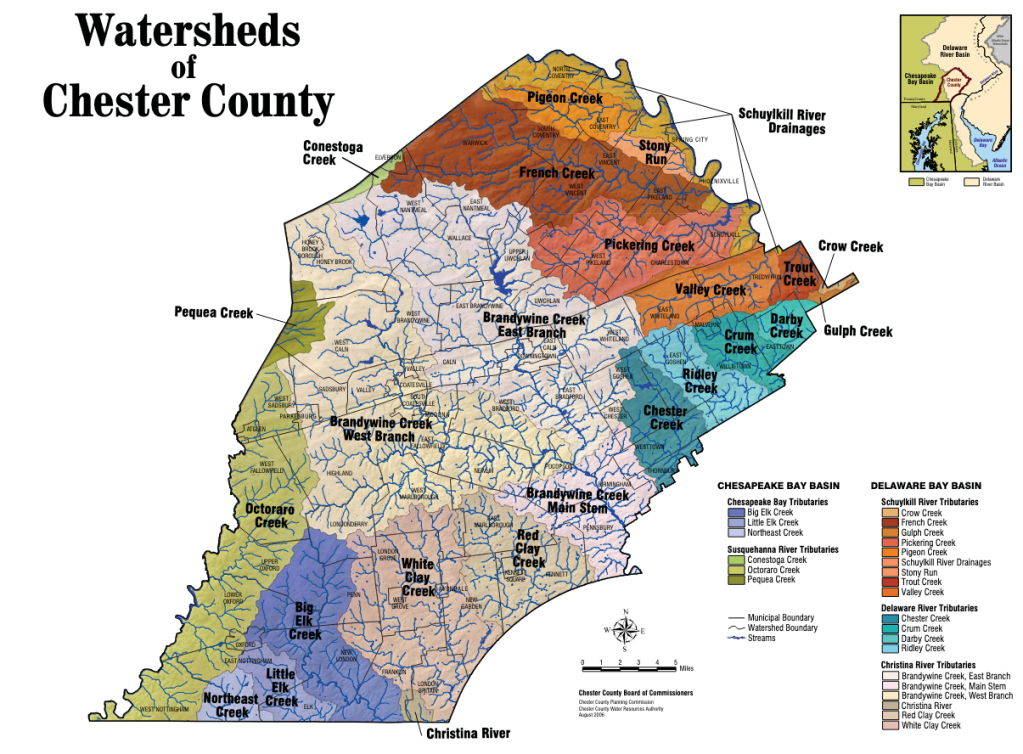
Watersheds of Chester County

Chester County’s history as a transportation hub and an early industrial and commercial center depended on its geography. On the map below for your reference, from Chester County, the reddish watersheds empty into the Schuylkill River, the bluish ones directly into the Delaware River, the pale-colored ones in the center into the Christina River (which flows into the Delaware 2 miles from Wilmington), and in the southwest, into Chesapeake Bay, whether via the Susquehanna River (greenish) or directly (purplish).

Info on hydrogen

Hydrogen is a contentious and potentially explosive way of storing energy created by other means (and that’s the crux of the matter, along with whether hydrogen is the best energy to use in certain specialized situations). It’s in the news because under the Inflation Reduction Act, the US government is generously subsidizing research and models of use, and because the PA government has been committing big taxpayer funding in a bid to sponsor a plant tied to the fracking industry.

Here are some articles with links—not always in agreement with each other—contributed by several CCEA members who were present at our Jan. 21 meeting:

 “Hydrogen Folly Grows: 55% Used In Oil Refineries — Demand Will Drop, Not Rise,” by Michael Barnard, CleanTechnica, 3/13/21

“Reclaiming Hydrogen for a Renewable Future: Distinguishing Oil & Gas Industry Spin from Zero-emission Solutions ,” by S. Saadat and S. Gersen, EarthJustice, 8/21 (41 pages; see also “Summary for Policymakers“).

“How Green is Blue Hydrogen?,” by R Howarth and M. Jacobson, Wiley Online LIbrary, 8/12/21.

“Hydrogen: Future of Clean Energy or a False Solution?.” by Cara Bottorff, Sierra Club, 1/4/22.

“Environmental Health Project (EHP) Statement on the Public Health Impacts of Blue Hydrogen Production,” Environmental Health Project, by Alison L. Steele, 8/3/22.

Blue Hydrogen: A Threat to Public Health?,” Environmental Health Project, 8/16/22.

“The hydrogen bill gifts $4 billion to the fossil fuel industry, by Patrick McDonnell, PennFuture, 10/25/22.

“Biden’s dilemma: How do you define ‘green’ hydrogen?,” by David Iaconangelo, EnergyWire, 12/23/22.

“Should We Really Use Renewable Electricity to Make Green Hydrogen? Not Always,” by Gary J. DiElsi,  Power Magazine, 1/3/23

“Blue Hydrogen: What You Need to Know,” Environmental Health Project (video of panel discussion), 1/25/23.

“Cheap clean hydrogen? Not so fast, energy giants say,” by David Iaconangelo, EnergyWire, 2/9/23.

Thoughts on hydrogen and carbon

by Bill Haaf

Carbon capture is being recommended by climate scientists as mandatory to keep earth from overheating. There are lots of techniques with trade-offs and potential misuse by oil/gas companies but we still need it.

I am preparing a PowerPoint reviewing both nature-based and man-made technologies to capture CO2 and sequester it. This will review pros/cons and potential misuses. I could present a 45-minute talk to any groups that wishes, with Q&A on various carbon capture types including trees and soil and oceans.

in addition to the fact that climate scientists say we need carbon capture to stop the planet from overheating, the oil / natural gas companies are moving fast to build these units..

The government must require the fossil fuel industry to capture all the CO2 from the burning of their products – not just their site energy use but from the end users as well.

Green Hydrogen is overhyped and way too much $$ being  spent on it.

We should not use renewable electricity to manufacture green H2 — IF this means grid electricity is dispatched to fill those energy needs, since then non-renewable electricity will be used. Much better to send as much renewable as possible to the grid to lower carbon footprint.  

So when should renewable electricity be used to generate green H2 ? When the grid has excess renewable energy from too much wind at night or sunny days.

Some relevant questions:

• Why make green H2? What end uses of green H2 would lower the carbon footprint?

• H2 is the smallest molecule; it leaks easily and explodes easily. Facilities need special metal or plastic so the process does not embrittle metal or leak out of valves, etc.

• H2 takes energy to compress and pump.

• It does not contain as much energy as methane. so can only displace 5-10% methane in boilers. 

* Most H2 these days is used in refineries for fuel (which we hope will go away)

* EV cars are more efficient. 

• H2 is good to replace coke in steel manufacturing and to use in fuel cells; maybe for heavy trucks (or will batteries win?)?

• Good for making NH3 as fertilizer OR use NH3 as fuel in ships or large vehicles.

Some background info:

“Hydrogen Folly Grows: 55% Used In Oil Refineries — Demand Will Drop, Not Rise,” by Michael Bernard, CleanTechnica, 1/13/21.

Summary: “Governmental expenditures on hydrogen are very useful, … but should be very carefully targeted to where they actually add value, which is almost entirely in displacing black and gray hydrogen in non-oil and gas markets with green hydrogen.”

“Should We Really Use Renewable Electricity to Make Green Hydrogen? Not Always,” by Gary J. DiElsi,  Power Magazine, 1/3/23.Summary: “There’s a growing belief that hydrogen will play a key role in lowering CO2 emissions. However, there are several caveats in realizing that vision, and in some cases, hydrogen may not be the right choice.” In addition, “Green hydrogen is not always free of CO2.”

Common Environmental Agenda for Chester County, 2022

Download the full 26-page pdf HERE.

CCEA’s Common Environmental Agenda is a comprehensive series of recommendations made to the Chester County Commissioners by some of the member groups of CCEA plus other organizations. Thanks to all who participated in creating it and in advance to the Commissioners for their careful attention to it!

From the Introduction:

As time passes, it is increasingly clear that our environment needs to become a higher priority for us all. We deserve — as written into the Pennsylvania Constitution (Article 1, section 27) — clean air to breathe, clean water to drink, and protected natural spaces. All of these rights, unfortunately, are threatened by many circumstances….

Man-made climate change has gone from a distant threat to a present danger; it is time for us all, as a Countywide community, to do our part to usher in new ways of sustainable living and long-term decision-making….

Brandywine in flood, Pocopson, 2021

We commend the Chester County Commissioners and the Environmental and Energy Advisory Board for finalizing the County’s first Climate Action Plan in 2021, giving our County a road map of how to mitigate our own impacts on climate change and improve the resiliency of our communities.

As groups that focus on environment and sustainability, we are conscious also of working within a society that prioritizes human needs such as housing, health care, education, and family-supporting jobs… Our solutions moving forward must be creative, just, and intersectional. This Common Environment Agenda is just the beginning.

Geothermal plant, West Chester University

The undersigned groups have come together to present achievable solutions to the Chester County Board of Commissioners, divided into eight issue areas, with a specific list of recommendations for each topic. Many of these solutions and programs are already being discussed or acted upon in many parts of Chester County….

We believe that the county is the best governmental entity to lead in environmental progress because it is of manageable size and united purpose, its municipalities need coordinated guidance and assistance, and we cannot always count on the state and federal governments to implement far-sighted policies. Therefore, we look forward to working with the Commissioners and the Chester County Environment and Energy Advisory Board as well as the County’s various departments to implement the following solutions.

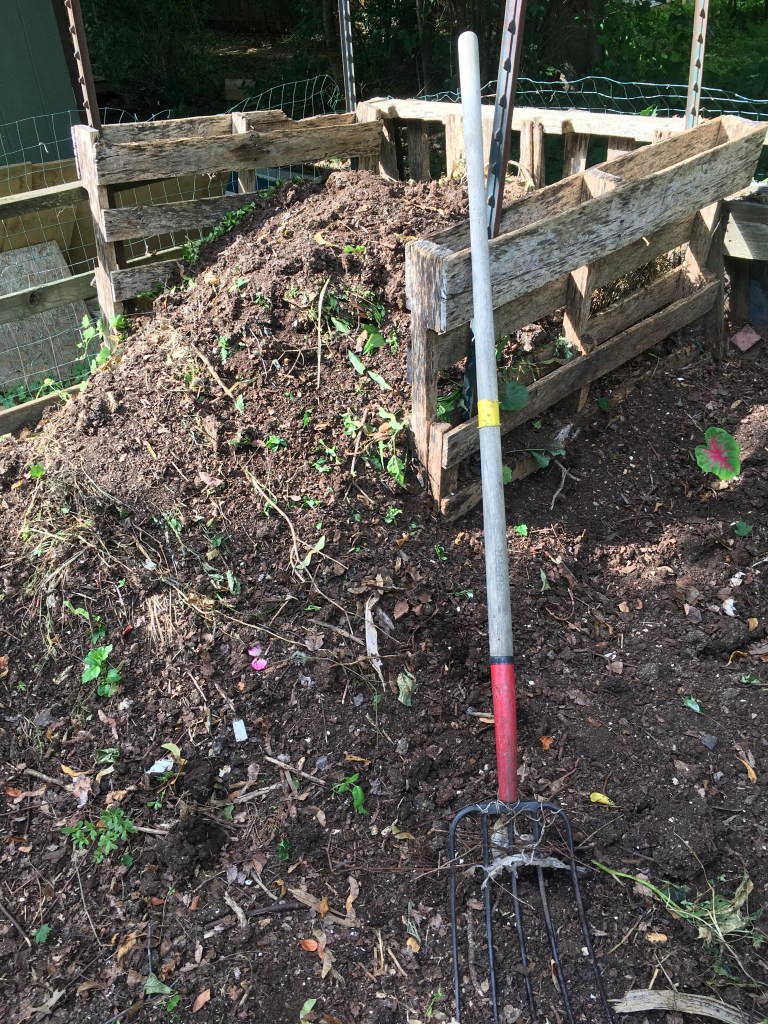
Backyard compost pile

Contents:

Water
Open Space & Development
Clean Energy
Transportation
Public Health & Toxins
Consumption & Waste
Resiliency

Chester County Climate Action Plan

Happy Climate Week in Pennsylvania (Sept. 18-25)!

We are fortunate to live and carry out our activities in a county whose Commissioners adopted a Climate Action Plan in October 2021.

“The plan was prepared by the Chester County Planning Commission in partnership with the County’s Environmental and Energy Advisory Board. The Climate Action Plan provides a blueprint for reducing greenhouse gas emissions and increasing energy efficiency at County government facilities and community-wide.”

See full details on the County’s Climate Action page.

West Chester Porchfest, May 21, 2022

by Margaret Hudgings

Inspired by Transition thinking, the West Chester Green Team formed a committee and created a music festival for West Chester. 

What is Transition?  It is an international movement started in the UK whose goal is helping communities as they transition to a new economy–away from fossil fuels and to healthier forms of energy.  When people are in transition, they can feel isolated and lost.  They can also lack the skills needed to thrive in a new economy.  Transition towns try to address these issues.  They focus on teaching and modeling skills such as gardening, repairing items of all sorts, founding a buy nothing economy so people can offer items they no longer need to others who need them, and also creating celebrations to help everyone through challenging times.  Thus, WC Porchfest was born.

The Green Team followed the model of another international movement in creating this event locally.  PORCHFEST originated in Ithaca NY in 2007.  It has now spread across the US and Canada. Porchfest events bring local musicians and neighborhoods together to celebrate and create a sense of community.  We used the blueprint of Porchfest in Binghamton, NY provided to us by a member who has attended other Porchfest events.

Our committee had representatives recruiting bands and front porches, getting sponsorships, interfacing with local government, making maps, arranging food trucks, interfacing with the local community and handling publicity.  Saturday, May 21 is Porchfest Day.  Hoping now for lovely weather and lots of fun.

The GT Porchfest Committee projected about 20 musical acts for our first year but closed registration when we reached 52.  We also have 36 front porches and a local church which is welcoming attendees by setting up outdoor tables with seating for 50, adjacent to a gathering of food trucks. 

The musical acts range from jazz to classical with lots of rock and some unique additions such as a performance of organ grinder music boxes by a local collector and a Japanese singer who will also demonstrate how to dress in kimono.  A local dance studio will perform in the park. Children’s activities will be there and include arts and crafts, planting and a musical instrument petting zoo. 

The local food co-op will provide free strawberry shortcake, and the Buy Nothing group will host an old fashioned white elephant fishing pond.  We have also added in 2 porch displays of our environmental work, one based on Doug Tallamy’s vision of planting native species of flowers and trees and another featuring our newest Dark Sky Committee.  

We benefited from the help of local leaders with Mayor Lillian DeBaptiste cosponsoring the event.  We highly recommend the Porchfest model for community outreach, as we are connecting with a new demographic.  We are not preaching to the choir as so often happens with green events. And Porchfest is upbeat.  It is essential to inspire and energize our supporters and this event seems an excellent vehicle for delivering our message.  

CO2 Budget Trading Program / RGGI

On Earth Day, fittingly, Pennsylvania joined the Regional Greenhouse Gas Initiative. Year by year, the cap on CO2 emissions from power plants decreases and as a result utilities will have to decrease their carbon pollution or pay more to pollute the rest of us.

The state will then invest hundreds of millions of dollars in fees to improve air quality through measures like energy efficiency and clean energy promotion.

It’s about time for this, because for over a century our state’s power plants have been paying no compensation to emit pollutants that damage the environment and human health. Now, they stop or they pay!

Finally PA joins the northeastern states and the large embarrassing gap in the map of RGGI states from C2ES can be colored in!

Read more from the Sierra Club , the RGGI site, and on our own site.

Tredyffrin Rain Garden Program

from Tredyffrin EAC

Tredyffrin Rain Gardens is a program started in 2021 by the Tredyffrin Environmental Advisory Council and the TE Green Team to take action on stormwater and water pollution in our Township. This volunteer-led group has installed an educational rain garden at the Tredyffrin Public Library and will be launching the residential rain garden program in 2022.

Rain gardens are excellent for areas like Tredyffrin, which has seen significant damage from stormwater. …

Beginning on January 10, 2022, residents of Tredyffrin can apply to receive a rain garden on their property. Residents will have a co-pay of $100 and will have an obligation to take care of the garden for many years, will have to display a sign, will have to volunteer hours back to the program and more. However, the remaining cost of installing the garden will be covered by a grant the Township received and with volunteer hours. This is neighbors helping neighbors to solve a problem that affects us all.

Read the full post at Tredyffrin EAC

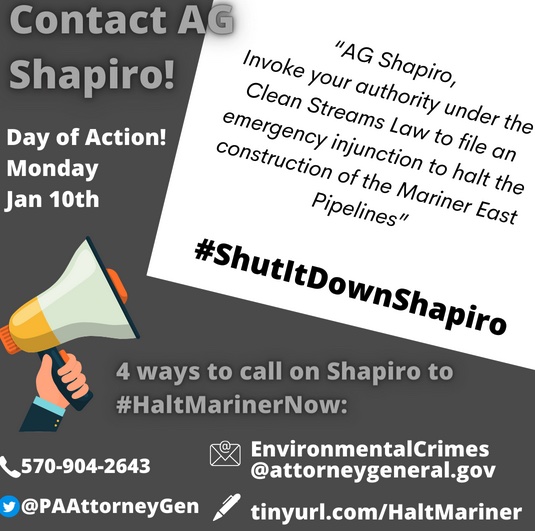
AG Shapiro, halt construction!

Today, Monday January 10th, contact PA Attorney General Josh Shapiro and demand that he file the emergency injunction of Mariner East pipeline construction and the nuisance lawsuit, as requested by Pennsylvania legislators last week. 
In October 2021, the PA Attorney General’s office announced 48 criminal charges for environmental crimes against the operator of this dangerous pipeline. Despite this, the state’s Department of Environmental Protection approved new permits at this site. And now Marsh Creek lake continues to be contaminated as construction resumes.

This is an opportunity for Josh Shapiro to show us what kind of leadership Pennsylvanians could expect from him, should he be elected to Governor in 2023. Help protect the clean water and natural beauty of Pennsylvania. 
🖊 tinyurl.com/HaltMariner
📞 570-904-2643
📧 EnvironmentalCrimes@attorneygeneral.gov