Category Archives: Environmental Justice

Environmental Justice

Environmental Justice (EJ) is a vital issue that takes us beyond environment. People have caused environmental degradation and social inequality, just as they have caused disparities in medical treatments and health treatment outcomes. Thus people alone can solve the resulting problem of wealthier people generally having everyday access to better environmental conditions and resources than those less socioeconomically fortunate. The key to change is, as always, grassroots action and community involvement, which in turn educate public officials and lock in progress.

As the Pennsylvania Constitution (I.27) proclaims, environment is for “all the people”:

“The people have a right to clean air, pure water, and to the preservation of the natural, scenic, historic and esthetic values of the environment. Pennsylvania’s public natural resources are the common property of all the people, including generations yet to come. As trustee of these resources, the Commonwealth shall conserve and maintain them for the benefit of all the people.”

The following information is adapted from a presentation by Maurice Sampson II at the January 27, 2024, meeting of CCEA and subsequent discussion, including his outline of the main concepts:
Chester County, prosperous though it is overall, has its own EJ areas. Historically in our society, toxic manufacturing and processing facilities have always been concentrated in minority areas.

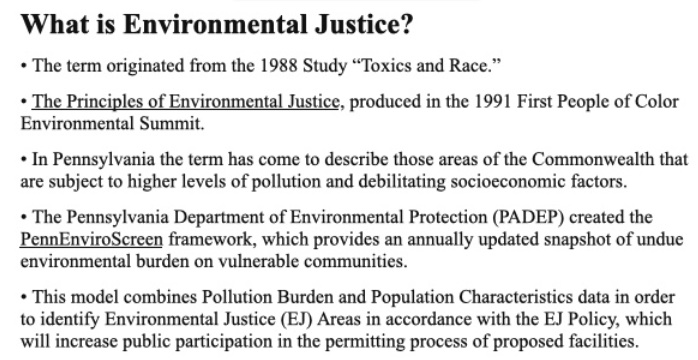
The PA Department of Environmental Protection (DEP) revised its Environmental Justice policy in 2023 and has developed PennEnviroScreen to evaluate the environmental burden of communities. High scores, based on both environmental and socioeconomic factors, designate EJ areas. In those areas the community is currently allowed to be involved in the permitting process for proposed facilities, but that means participation in discussion not in decision-making.

PA House Bill 652, under consideration in Harrisburg, provides more of a mandate, requiring every permit to take into account cumulative impact, rather than allowing development to proceed as if there is no other pollution already in place in the area. Under this bill, DEP could reject applications based on community participation and cumulative impact. See more on HB 652 here. Organizations for Pennsylvania’s  Environmental Justice Bill HB652 includes a letter of support that organizations are invited to endorse; individuals can sign on here.

Chesco currently has 5 EJ areas with scores over 80: Modena 97, Valley Twp 95, Honey Brook Twp 87, N. Coventry Twp 84, Coatesville 80. And just behind those, in the 70s: Penn Twp and Sadsbury Twp 79, Oxford Borough 78, New Garden Twp 74, West Chester Borough 73.

This EnviroScreen model combines pollution burden, health, and demographics to identify EJ areas. Underlying info includes pipelines and other environmental factors, plus social factors like poverty and race. But ratings are not only for Black and Brown people; the tool raises standards for all areas and issues. We can’t solve these problems from the top down, but need to start within the communities. We need to talk to people in place and go to their meetings. The poor have the intellect and understanding of the problem but they lack the resources and political clout to solve the problem on their own.

After Maurice’s presentation, others added further info. POWER is actively addressing environmental justice in Phila and Bucks, Montgomery, Delaware, Chester and Lancaster counties.  Its Climate Justice & Jobs team meets regularly; see info posted on our site here. Their branch called POWER Metro focuses on the Philly suburbs. See also the PA Dept of Health’s Environmental Justice Strategic Plan, connecting environmental justice and health equity.

The Coalition for the Delaware River Watershed concluded from a discussion with EPA that no community is too small to be focused on. Modena (southeast of Coatesville) has the lowest score in Chesco; we need volunteers to find out what is being done there to help. Every neighborhood has people and organizations that love their neighborhood and would never leave it, and EJ areas are no exception. Working on Environmental Justice in Chester County will require finding and building relationships and working in alliance with community organizations (not necessarily environmental ones) in the impacted municipalities.

EPA’s web site has an EJ section including a geographical microdata tool, that helps link health to contamination. An EJ conference is in the planning for 2025, with the objective of building a next network of Environmental Justice organizations.

POWER Interfaith

by Kathy McDevitt

POWER Interfaith is “a grassroots organization of Pennsylvania congregations and individuals committed to racial and economic justice on a livable planet.”

I attended the excellent POWER interfaith team meeting on Jan. 30, 2024.  One of their five focus areas is Climate Justice.  Below are slides of their accomplishments and goals in the climate justice area.  They could definitely be strong allies for those of us working in that field.

PADEP policy on environmental justice

The Pennsylvania Department of Environmental Protection’s revised Environmental Justice policy of September 2023 is helpful to groups like ours in making the case for our pro-environment and pro-people policies. Here is the underlying definition that we must strive to be worthy of:

Environmental Justice (EJ) — Environmental justice means the just treatment and meaningful involvement of all people, regardless of income, wealth, race, color, national origin, area of residence, Tribal affiliation, or disability, in agency decision-making and other activities that affect human health and the environment so that people: are fully protected from disproportionate and adverse human health and environmental effects (including risks) and hazards, including those related to climate change, the cumulative impacts of environmental and other burdens, and the legacy of racism or other structural or systemic barriers; and have equitable access to a healthy, sustainable, and resilient environment in which to live, play, work, learn, grow, worship, and engage in cultural and subsistence practices. It further involves the prevention of future environmental injustice and the redress of historic environmental injustice.

Environmental degradation affects everyone through the heating climate, violent weather, chemical pollution, and much more; but it has the greatest negative impact on those who cannot afford to relocate out of a flood plain, live in a leafy neighborhood, eat organic food, drink lead-free water, and all the other advantages of disposable income.

You can download the full DEP text here. It is now in effect but could be revised based on public comments received up to November 30.

Here is the paragraph describing the purpose of this update:

The purpose of the policy is to facilitate environmental justice in
communities across the Commonwealth of Pennsylvania and to ensure
equity and environmental justice in the administration of DEP’s
constitution, statutory, and regulatory duties. This policy outlines
measures that DEP will take to proactively educate, engage, and empower
Pennsylvanians living in EJ Areas across the Commonwealth; ensures
enhanced opportunities for community involvement and public
participation in the permit application process for permits in EJ Areas;
explains how DEP will prioritize Environmental Justice in its compliance
and enforcement activities; identifies DEP grant opportunities to facilitate
environmental justice; and, identifies mitigation and restoration practices
for consideration by applicants for projects in EJ areas that have been
impacted by environmental issues. DEP also seeks to make its permitting
process more efficient and expeditious by integrating the Office of
Environmental Justice (OEJ) in the process to lead the policy’s Enhanced
Public Participation guidelines, while also ensuring the use of best practices and timely execution of the community engagement process.

Please note that the CCEA Common Environmental Agenda, presented to the County Commissioners in 2022, includes many recommendations on environmental justice; see that document here and search both justice and income.

Here’s how the DEP describes the current “interim final” policy updating its 2004 predecessor:

After extensive public comment reviews and policy revisions, DEP adopted an interim final Environmental Justice Policy on September 16, 2023. Additionally, DEP has an improved mapping tool to better identify EJ areas within the Commonwealth and has an expansive and elevated Office of Environmental Justice (OEJ). There will be a formal public comment period until November 30, 2023. The EJ Policy from 2004 will only apply to permit applications received before September 16 and grant applications relating to materials released before September 16.

The interim-final EJ Policy includes several sections that enhance the previous Environmental Justice Public Participation Policy which had been in effect since 2004.

As always, implementation will be key. The policy applies explicitly only to DEP applications and authorizations, and:

The policies and procedures outlined in this guidance are intended to
supplement existing requirements. Nothing in the policies or procedures
shall affect regulatory requirements.

The policies and procedures herein are not an adjudication or a regulation.
DEP does not intend to give this guidance that weight or deference. This
document establishes the framework within which DEP will exercise its
administrative discretion in the future. DEP reserves the discretion to
deviate from this policy statement if circumstances warrant.

So, that is a challenge to groups and individuals concerned about environmental justice: to press DEP to follow its own “guidance” and others to adopt it.