The Pennsylvania Common Conservation Agenda

In 2018, CCEA member PennFuture presented its Green in ’18 campaign, with an eye to securing commitments from the then gubernatorial candidates.

At the same time, a Pennsylvania Common Conservation Agenda was worked out by 25 environmental groups including CCEA members Conservation Voters of Pennsylvania, PennEnvironment PennFuture, and Sierra Club. Download that document here: Updated-Final-Version-of-the-PA-Common-Conservation-Agenda-5.1.18.

PennFuture explains:

PennFuture has been working with 20+ environmental, land, air, and water groups and organizations to identify the biggest environment challenges facing Pennsylvania. As a result, this coalition has created and agreed upon the most promising policy solutions to these threats. This process led to the creation of the first-ever Pennsylvania Common Conservation Agenda, a blueprint for restoring and preserving our life-sustaining natural resources.

Not only do these solutions promote a healthier environment and a stronger economy, they are publicly popular, fiscally responsible, and can be enacted by our next Governor using his or her executive authority. In virtually every instance, increases in state spending will be offset through job growth, revenue growth, energy savings, and/or lower healthcare costs….

The points in the Pennsylvania Common Conservation Agenda are:

1. Strengthen the 21st Century Workforce through Green Jobs
2. Champion the Great Waters of Pennsylvania from Source to Tap
3. Provide the Department of Environmental Protection and Department of Conservation and Natural Resources with
the Needed Resources to Fulfill Their Missions
4. Improve the Department of Environmental Protection’s Ability to Protect the Public from Threats Posed by NaturalGas and Petrochemical Infrastructure
5 Ensure Environmental Justice for Vulnerable Communities
6 Boost Current Investments in Growing Greener
7 Bolster the Commonwealth’s Clean Energy Sector

These valuable goals remain works in progress. Two underlying principles from the Introduction are:

• a healthy environment renders possible the governance, education, business, and recreation that the people who live and work in our Commonwealth need, expect, and depend on

• a healthy environment is compatible with a strong business climate

And here are a few painful reminders of how much needs to be done:

• Pennsylvania has the third worst air quality in the United States

• Pennsylvania’s poorest residents are often the ones who live next to polluting industrial facilities, such as power plants, factories, transportation hubs, gas wells, and other sources of pollution

• Attracting greater clean energy investment to Pennsylvania will require the Commonwealth to solve numerous financing challenges that currently hinder the state’s clean energy industry

Read the full report!

Otten introduces plan to amend Pa. constitution for local self-government

[Why is this important for environment and sustainability? The US says states can’t protect themselves (e.g., by setting their own gas mileage standards) and the state says counties and municipalities can’t protect themselves (e.g., by regulating petroleum products pipelines). It’s time for municipalities to take back the right to work for the health, safety and welfare of their own residents. If the state of Pennsylvania cannot adequately implement its own constitution’s environmental rights amendment, then the levels of government closer to the grassroots need to do the job.]

Rep. Danielle Friel Otten, October 3, 2019 | 5:13 PM

Area officials support efforts

EXTON, Oct. 3 – State Rep. Danielle Friel Otten, D-Chester, today announced a proposal for an amendment to the Pennsylvania constitution.
Otten’s amendment, H.B. 1813, would allow municipal governments to enact laws protecting the health and safety of their communities without interference from corporations or pre-emption by the state or federal government.

“Today, I stood with local elected officials and members of our community to announce a proposal for an amendment to the Pennsylvania constitution that would recognize the fundamental right of the people to local self-government and place the rights of citizens over the interests of private corporations,” Otten said. “Under current law in Pennsylvania, corporations can sue state and federal governments to override community attempts to protect themselves from projects with the potential to cause great personal or environmental harm. It is time we correct that failure.”

Otten was joined by Uwchlan Township Supervisor Bill Miller, West Chester Mayor Dianne Herrin, community organizer and Downingtown Area School Board director Rebecca Britton, PA Community Rights Network President Malinda Harnish Clatterbuck and a volunteer leader with the Pennsylvania chapter of Moms Demand Action, Erin Buchner.

Miller noted the current inability of townships to regulate the proliferation of cellular towers, the presence of guns in local parks or the sale of fireworks within township borders.

Uwchlan Township Supervisor Mayme Baumann also expressed support for the proposed amendment, stating, “Pennsylvania is a diverse patchwork of rural townships, suburban areas, small towns, and cities. This amendment would help us create a government that better reflects the values of our communities and gives municipalities the ability to protect their residents’ health, safety and natural resources.”

Britton discussed the importance of the legislation for communities living with pipeline construction, noting that “we the people can no longer protect our property as guaranteed us by the Pennsylvania constitution, because a private entity is shipping off our natural resources for plastics production, and in turn has put our private property at risk.”

Buchner commented on the need for the amendment as it relates to gun safety.

“Pre-emption laws override commonsense. In Pennsylvania, the state legislature has prohibited guns in the state Capitol and on state properties, while at the same time it pre-empts local governments from restricting guns in municipal buildings or in any city or town hall.”

Herrin described the ways that pre-emption ties her hands as a mayor on issues including gun safety, environmental initiatives, and taxing authority.

“We have a $20 million unfunded pension liability in West Chester because we have a large police force,” Herrin said. “I can’t protect my constituents from carrying the tax burden because the state will not allow us to generate revenue in any other way than through three very limited taxing authorities.”

Harnish Clatterbuck discussed the impact when a pipeline project called Atlantic Sunrise came through her Lancaster County community.

“We discovered that a company in Oklahoma had more power to do on our property what they wanted than we had the right to stop them. We were overruled by the regulatory agencies and by pre-emption, which has allowed our elected officials in Harrisburg and Washington to violate the health and safety of the people they have been elected to represent.”

For more information, those interested can call Otten’s office at 484-200-8259.

The 17 Sustainable Development goals


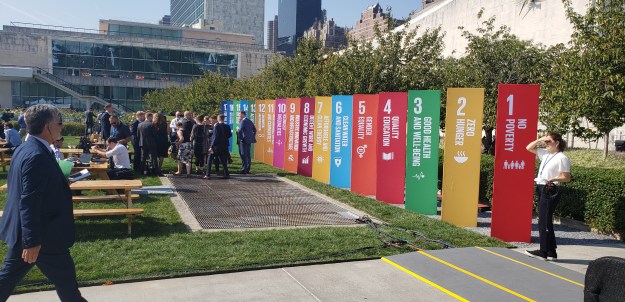
Photo by Richard Whiteford at the Climate Action Summit at the UN, taken 9/23/19

See more on the 17 goals here.

“The Sustainable Development Goals are the blueprint to achieve a better and more sustainable future for all. They address the global challenges we face, including those related to poverty, inequality, climate, environmental degradation, prosperity, and peace and justice. The Goals interconnect and in order to leave no one behind, it ís important that we achieve each Goal and target by 2030….” And also:

How does climate change relate to sustainable development?

Climate change is already impacting public health, food and water security, migration, peace and security. Climate change, left unchecked, will roll back the development gains we have made over the last decades and will make further gains impossible.

Investments in sustainable development will help address climate change by reducing greenhouse gas emissions and building climate resilience.

Conversely, action on climate change will drive sustainable development.

Tackling climate change and fostering sustainable development are two mutually reinforcing sides of the same coin; sustainable development cannot be achieved without climate action. Conversely, many of the SDGs are addressing the core drivers of climate change.

Here are the 17 Sustainable Development Goals:
Goal 1 End poverty in all its forms everywhere
Goal 2 End hunger, achieve food security and improved nutrition and promote sustainable agriculture
Goal 3 Ensure healthy lives and promote well-being for all at all ages
Goal 4 Ensure inclusive and equitable quality education and promote lifelong learning opportunities for all
Goal 5 Achieve gender equality and empower all women and girls
Goal 6 Ensure availability and sustainable management of water and sanitation for all
Goal 7 Ensure access to affordable, reliable, sustainable and modern energy for all
Goal 8 Promote sustained, inclusive and sustainable economic growth, full and productive employment and decent work for all
Goal 9 Build resilient infrastructure, promote inclusive and sustainable industrialization and foster innovation
Goal 10 Reduce inequality within and among countries
Goal 11 Make cities and human settlements inclusive, safe, resilient and sustainable
Goal 12 Ensure sustainable consumption and production patterns
Goal 13 Take urgent action to combat climate change and its impacts*
Goal 14 Conserve and sustainably use the oceans, seas and marine resources for sustainable development
Goal 15 Protect, restore and promote sustainable use of terrestrial ecosystems, sustainably manage forests, combat desertification, and halt and reverse land degradation and halt biodiversity loss
Goal 16 Promote peaceful and inclusive societies for sustainable development, provide access to justice for all and build effective, accountable and inclusive institutions at all levels
Goal 17 Strengthen the means of implementation and revitalize the global partnership for sustainable development

Chester County Clean Energy Tour

Don’t miss it: Saturday, October 19, 2019, 10:00 am – 4:00 pm

Did you know Chester County is a state leader in solar energy and energy efficiency? Across the County, 20.88 MW are produced in 839 Installations (#2 in PA). Join us for a tour of exemplary clean energy projects at our schools, universities, businesses, farms, non-profits, municipalities and homes. Be inspired at this FREE event that features self-guided tours and open house tours across the County.

The logos to the left show sponsors of the Chesco tour. There will be more! Note that Chester County’s topic for the day is much broader than the national solar theme.
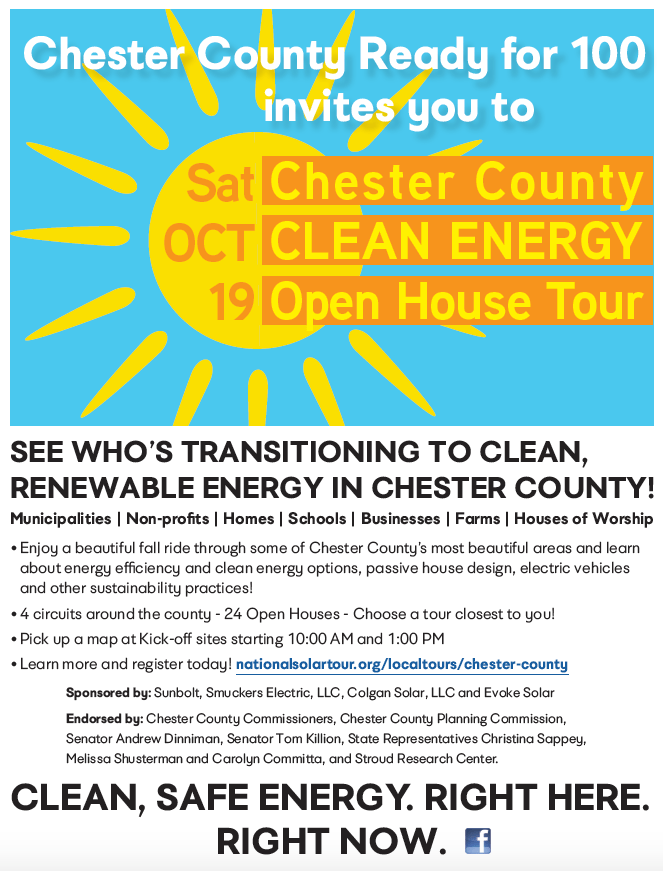
Kick-off events will provide an orientation and suggested route. The homes, businesses, and public places you visit will demonstrate green technologies such as solar, wind, geothermal, green design, energy efficiency, electric vehicles and more. Learn how your home, workplace, local schools and municipal facilities can be part of the transition to cleaner, safer renewable energy.

Register to attend the tour here.

Be part of the largest national renewable energy event ever and be one of the many forward-thinking hosts or participants from across the country!

The tour is coordinated by Solar United Neighbors and the American Solar Energy Society, with help from Chester County Ready for 100% Renewable. See more about the nationwide National Solar tour here.

CCEA delegates strategize

On Sept. 14, delegates of the Chester County Environment Alliance met productively for 2.5 hours.

Please Like the CCEA public Facebook page to stay up to date on local meetings, other groups you might find of interest, and upcoming events like the Clean Energy Open House Tour on October 19.

The Chester County Environment Alliance brings the representatives of its groups together three times a year to discuss the issues affecting our environment, help each other amplify our messages, coordinate events and campaigns, and use our resources jointly to help our shared mission to preserve and protect our environment and encourage sustainable choices in everyday life.

Please spread the word about this growing initiative as we work together with our friends and neighbors to preserve our environment on so many worthy fronts.

New study shows PA missing valuable opportunities to tap into clean energy

Penn Environment Release, August 22, 2019 [An important read! Some good news but overall, PA, “getting only 3% of its total energy from wind and solar today,” needs to do better!]

[Philadelphia, PA] — According to a new study released today by the PennEnvironment Research & Policy Center, Pennsylvania has seen major increases in the amount of electricity it gets from the sun and wind since 2009, but the report shows that the Commonwealth isn’t keeping up with many of the states that are more aggressively tapping into clean energy opportunities.

The report, Renewables on the Rise: A Decade of Progress Toward a Clean Energy Future, compares Pennsylvania to other states in the nation through a state-by-state assessment of the growth of key technologies needed to power the Commonwealth and nation with clean renewable energy, including wind, solar, energy efficiency, energy storage, and electric vehicles. Pennsylvania ranked 22nd for solar, 20th for energy efficiency, 16th for wind, and 8th in battery storage for growth between 2009 and 2018. The report showed encouraging progress over the last decade, while also highlighting the need for increased action at the state and federal level to make the Commonwealth a clean energy leader.

“Every day, there’s more evidence that a future fueled by renewable energy is within our reach,” said Flora Cardoni, Climate Defender Campaign Director for the PennEnvironment Research & Policy Center. “The progress we’ve made in the last decade on renewable energy and technology, like battery storage and electric cars, should give Pennsylvanians confidence that we can take clean energy to the next level. But there is still a lot of work to do to catch up to other states around the country and become a clean energy leader.” …

There’s no time left for business-as-usual; the climate crisis is here

from DC Climate Strike, 9/20/19

On September 20th, hundreds of thousands of young people across the globe are taking to the streets to take a stand, many of whom were inspired by the actions and words of Swedish student Greta Thunberg. They include and will join Indigenous peoples, as well as Black and Brown communities on the frontlines, who have been leading the climate movement and building a regenerative future in the midst of the climate emergency. We are inspired by First Nations, who are waging some of the most powerful fights of our time against fossil fuel infrastructure.

People around the world are experiencing superstorms, floods, droughts, and wildfires at unprecedented rates, with low-income communities and communities of color hit first and worst. Cruelly, communities and regions being devastated already by the effects of climate change tend to be the least responsible for its onset. It is not a coincidence that climate impacts strike along the lines of race and class so starkly; climate change is a product of the same processes which cement racism and wealth inequality in our country and our world.

The transition off of fossil fuels is inevitable; justice is not. To achieve Climate Justice, we must not only decarbonize the atmosphere, but also decolonize and democratize our economies and our communities. Shutting down the nation’s capital could be our best shot at starting this justice-based transition; we need a broad-based coalition that emphasizes the overlap of our struggles. We look to the recent passage of the Climate & Communities Protection Act by New York Renews, a coalition led by Black, Brown, and labor organizations, for inspiration.

To achieve something as monumental as shutting down DC, we are going to need everyone to step up. We need everyone’s creativity, everyone’s energy, everyone’s insights, and everyone’s ideas. Every single person has skills and experience to contribute to the strike.

We do not take this action lightly. We know that this shutdown will cause massive disruption to people who bear little responsibility for the climate catastrophe we are facing. But we will also cause massive disruption for politicians, huge corporations and the lobbyists who control our government. We need to fundamentally change the power structure of the United States if we want to stop the climate crisis, and shutting down DC is a big step in the right direction.

This is the mass uprising that everyone with climate anxiety has been waiting for. This is an uprising for life itself, fighting back against the forces of destruction. This is your chance to take action to save the people, plants, and animals you love. Let’s rise up and shut down DC!

Dr. Jonathan Haidt on how moral psychology can inform climate advocacy

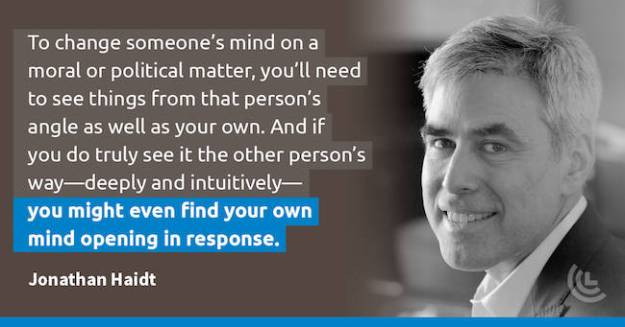
By Sara Wanous, Citizens’ Climate Lobby, 9/18/19 [Bad news from Dr. Haidt: data and reasoning don’t convince people! Briefly: we react by intuition before understanding; if a position doesn’t fit our own preconceived morality, it’s hard to convince us; our views hang together with those of the group we identify with. But isn’t our society’s underlying social ethos broadly shared? Not even close: “progressives give very high ratings to care and fairness as equality. Social conservatives rank care lower, view fairness as proportionality, and rank loyalty, authority, and sanctity higher.” Merits a detailed read.]

Each month, Citizens’ Climate Lobby hosts an online meeting featuring a guest speaker to educate listeners on topics related to climate change, carbon fee and dividend, and the Energy Innovation and Carbon Dividend Act. Check out recaps of past speakers here.

Citizens’ Climate Lobby is dedicated to bringing people across the political spectrum together on climate solutions. Our work on bipartisanship and relationship building is informed by experts committed to engaging more effectively with those who think differently than us, like Dr. Jonathan Haidt.

Dr. Jonathan Haidt is a professor of Ethical Leadership at the NYU Stern School of Business and the author of several books on the intersection of psychology and politics, including “The Coddling of the American Mind,” “The Righteous Mind,” and “The Happiness Hypothesis.” Most recently, Dr. Haidt has adapted one of his classes into an online learning platform called Open Mind to help people achieve just that. Dr. Haidt joined Citizens’ Climate Lobby’s September monthly call to share his expertise in moral psychology and how these lessons can help bring people together on climate solutions. …

read more and view video at Citizens’ Climate Lobby

Global Climate Strike in West Chester Sept. 20!

Nathaniel's avatarWest Chester Green Team

By Katrin

Don’t forget to come tomorrow to the Global Climate Strike in West Chester. It starts at 11:00 am at the Chester County Courthouse. We want to show the politicians that there are people out there who care for the future of our planet and are even willing to skip school or work.

After the rally there is going to be an
information event from 1:00 – 2:30 pm at the Academic Quad on the Campus
of West Chester University. Bring your strike signs and a lot of
motivation!

And if you’re still motivated, join us during the International Peace march on Saturday. At noon there is going to be a peace commemoration at the Courthouse and at 2:00 pm the Climate Action and Peace Rally starts.

Grab some friends and come to these important events. Time is running out – we need to act now!

View original post

Stop the Attack on Pennsylvania’s Clean Energy Future

Our energy grid operator is impeding renewable energy; who knew? Here’s an easy way to ask Attorney General Josh Shapiro to safeguard Pennsylvania’s clean energy policies (which of course always need improving, and certainly not undermining!):

from Union of Concerned Scientists

It’s likely that the main connection you have to our electricity system is your local utility, which directly provides you with your electricity and bills you monthly. But behind the utilities, there’s another system made up of regional grid operators, which coordinate the transmission of electricity from generators to local utilities who then distribute the power directly to you.

Unfortunately, your energy grid operator, PJM Interconnection, has been advocating for a rule that would undermine state clean energy policies and prop up fossil fuels and make clean energy costlier for consumers like you.

It’s up to state attorneys general to defend state laws, including renewable energy standards and other clean energy policies, from attempts to undermine them like this.

Write today and urge your state attorney general to speak out against PJM’s proposed rule and to stand up for clean energy momentum in your state.

It’s crucial that state leaders like your attorney general speak out against this dirty rule and stand up for the voices of consumers and constituents.

Sign the petition to AG Shapiro at Union of Concerned Scientists

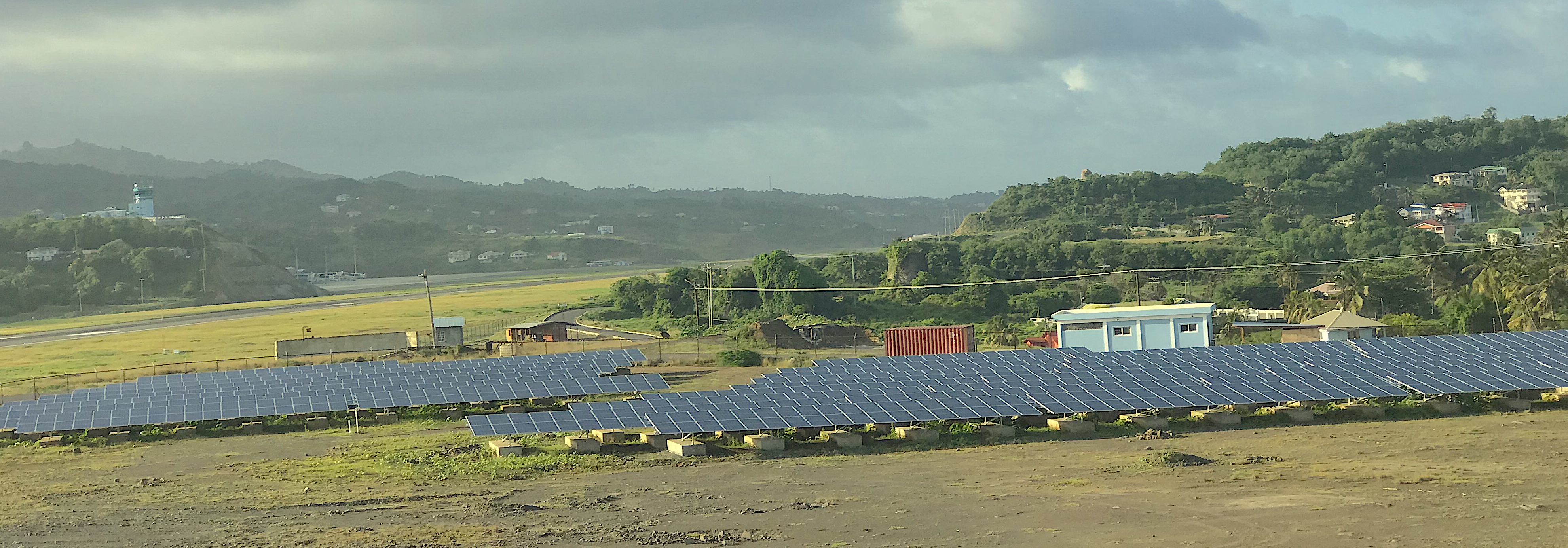
Solar energy on the ground