
Is your community considering a ban on single-use plastic bags? There are many advantages: cutting down on litter (which has to be picked up or it disfigures nature, reducing use of fossil fuel (from which plastic is made), reducing costs to businesses and consumers (someone has to pay for those throwaway bags), and reducing costly shutdowns to clean recycling equipment gummed up by bags.
How many plastic bags a year would be saved in your community, based on population? See Environment America’s Single-use Plastic Bag Ban Waste Reduction Calculator. (It’s based on population, at the rate of about 300 bags per resident; the tool takes a while to load; enter just the municipality, not state.)
What other factors need to be considered? See many resources at PennEnvironment, including a model ordinance.
What are the answers to some common issues that may arise as public officials consider a ban? Here are some points from a 12/31/22 memo from Maurice M. Sampson II of Clean Water Action to members of Philadelphia City Council as they considered strengthening the established ban by levying a fee of $.15 on all bags, whether plastic or paper. Download the 5-page memo here.
• Why is a fee for single-use carry-out bags necessary?
Experience shows that a straight ban on throwaway plastic bags multiplies the use of throwaway paper bags, which are more expensive. The most equitable solution is to add a flat fee for all bags a consumer uses to that consumer’s bill. Savings to the business from not having to buy and give away bags can be passed on to consumers. Consumers rapidly learn to carry their own reusable (and more resistant) bags.
• What is the impact of bag fees on low-income residents?
Studies show that low-income people adjust their behavior just like anyone else. Any exceptions to the fee would prevent businesses, whether large or small, from saving the cost of bags and would fail to reduce litter and environmental impacts locally.
Scary fact: every American consumes an average of almost one single-use plastic bag a day! Please try to make every day a day without a throwaway bag! And of course, never go shopping without the needed number of reusable bags.

Moving forward with the Chester County Single-Use Plastic Bag Ban Coalition! More info here.
[download pdf here]
During the February 22nd, 2022, meeting, the EAC’s single use plastic bag ordinance was initially presented to the Board of Supervisors. Following the presentation, the Supervisors asked for further information regarding the economics of single use plastic bag bans. The following is a summary of information to meet that request.
In general, single use plastic bags are economically problematic because they are derived from fossil fuels, are a source of litter on land and water, create tangles and jams in recycling and wastewater processing equipment and prove costly to municipalities in terms of time and money to manage. Most of the economic data currently available focuses on the economic costs of plastics rather than the savings associated with bag bans. However, there is supportive data regarding the role of bag bans and businesses/business owners.
For business owners, removing plastic bags from the list of supplies businesses require saves them money in the long run. Currently, single use plastic bags are offered to customers free of charge and are a cost business owners must account for in their pricing for goods and services. While the per unit purchasing cost of paper bags is higher than that of plastic bags ($0.15 versus $0.01) the proposed ordinance requires customers to pay for paper bags ($0.15 fee) so businesses can recoup these costs.
Prior to the statewide plastic bag ban in CA, San Francisco’s Office of Economic Analysis found the following: ‘Their models predicted a “slight positive impact on the local economy” due to the overall decrease in bag-related costs post-ordinance, and to the economic multiplier effects that could occur alongside the projected increase in consumer spending associated with decreasing product costs passed on by retailers. The same study reported that impacted San Francisco retailers would enjoy a savings of $3 million over the course of a year under the strengthened ban, due to the forgone purchasing costs of single use bags.1
Additionally, with the proposed ordinance, businesses will be given a 90-day transition period during which they can utilize their existing supply of plastic bags without risk of penalty. The length of this transition period was determined based on the findings of the business community survey conducted in Easttown Township during the fall of 2021.
Beyond local businesses, plastic pollution in costly to local municipalities, utilities, and services. Penn Environment states, “Bags are an economic burden on local governments and taxpayers, with millions of dollars in hidden, externalized costs.”2For example, the Clean Air Council of PA has estimated the production stream costs (from fracking to being thrown away) of plastic bags to be between $20-$30 per year for Philadelphia taxpayers. Removing these bags from a municipality ultimately removes this cost for the tax base.3
Within Philadelphia, the Water Department is spending heavily to pull litter out of sewer drains and other stormwater infrastructure. They estimate that plastic pollution is doubling the maintenance costs of their green stormwater infrastructure, requiring 32 dedicated cleaning crews to remove items from their infrastructure. In 2017, city crews removed 67 tons of debris from their stormwater system, much of it being single use plastics. It bears repeating, cleaning up this litter comes with additional costs to users.4
Furthermore, “a recent study by Keep Pennsylvania Beautiful estimated Pennsylvania spends $48 million a year to clean up litter. The report included an estimate that PennDOT spends approximately $13 million annually in roadside litter clean up.”5 On average, Philadelphia uses approximately 1 billion plastic bags each year, and it costs the city between $7 and $12 million dollars to remove them.6 New York City has similar numbers on an annual basis: “single-use, carry-out bags account for 1,700 tons of residential garbage each week, which equates to 91,000 tons of plastic and paper carry-out bags each year and presently costs the City $12.5 million annually to dispose of this material outside the city.”
Nationally, cities, towns, and businesses pay roughly $80 a ton for single use plastic bags to either be buried in landfills or be incinerated, both actions have high externality costs associated with them.7 Hypothetically, if we were to apply this figure to Easttown Township, we are roughly 1/800th the size of New York City and thus produce approximately 114 tons of plastic and paper carry out bags each year, or $9,120.00 in disposal costs.
Another major way single use plastic bags prove economically burdensome is for recycling facilities. “Single use plastic bags are the number one contaminant found in recycling facilities, clogging machinery and decreasing the efficiency of recycling programs in Pennsylvania that are often already struggling.”8
The extent of this problem can be demonstrated in San Jose CA, which spent nearly $1 million per year on repairing plastic bag related damages. In a similar case, a recycling factory had to close down up to six times a day in order to remove the trapped plastic bags in the machinery.” Several recycling facilities in NY have estimated costs associated with extra operational costs for removing single use plastic bags from their lines between $300,000 to $1 million per year.9
Beyond the local economic impacts, plastic pollution costs $13 billion in economic damage to marine ecosystems per year. This includes losses to the fishing industry and tourism, as well as the cost to clean up beaches.10 This includes local beaches like the Jersey Shore, where twice annual clean ups remove litter from the beaches and accessible waters. In 2017, 84% of the material collected was plastic or foam plastic and 66% of that number was of the single use variety including single use plastic carry out bags. On average, residents of coastal areas spend $15 per year to clean up their beaches in taxes.11
Finally, a cost-benefit analysis of the proposed plastic bags ban would be incomplete if the incalculable environmental damages caused by single use plastic bags was not mentioned.
Single use plastic bags are a petroleum product; they require 12 million barrels of oil annually to produce, equating to 4% of the world’s annual oil budget.12 The emissions associated with producing plastics will exceed those from burning coal by 2030.13 The economic costs of these emissions at the global level are unknown but the impacts to climate change and air pollution are considerable and long lasting. The Equinox Center in San Diego calculated that a plastic bag ban and fee model similar to the one proposed in Easttown Township would reduce San Diego’s energy (74 million Megajoules (MJ)), CO2 footprint (6,418 tons) and solid waste (270,000 kg) on an annual basis.14 Again, if we were to use these calculations at a per capita basis for Easttown, this would hypothetically equate to a CO2 footprint of 19.7 tons and 831 kg of solid waste for the Township.
Beyond global energy and emissions constraints, the major environmental risk posed by single use plastic bags is their inability to decompose. Over time, plastics degrade to smaller microplastics that can be ingested by the smallest species at the base of our aquatic and terrestrial food webs. Ultimately, limiting single use plastics in the food web limits our own intake of plastics from our food and water sources.
In summary, plastic bag bans reduce all these costs for municipalities, costs which are passed on to residents, by reducing the amount of plastic pollution and waste we need to handle. For businesses the impact is that a plastic bag ban with a fee on other bags reduces overall single use bag use. With less demand for bags, businesses don’t need to purchase and stock as many bags, saving them costs. And although paper is more expensive than plastic, having a built-in fee for paper bag covers the difference, so businesses don’t need to pay more.
Easttown Township has an opportunity to be one of the first local municipalities to pass an ordinance of this type and help push the envelope for our community.
1 “Plastic Bag Bans: Analysis of Economic and Environmental Impacts”. Equinox Center. Oct. 2013. https://energycenter.org/sites/default/files/Plastic-Bag-Ban-Web-Version-10-22-13-CK.pdf /.
2 Savitz, Faran. Email correspondence reg. economic benefits of a bag ban. Google. Mar. 2022.
3 Plastic Bag Ban Information Session #2 for Delaware County, PA. Logan Welde, Clean Air Council, 2/8/2022.
4 “Looking to Cut Plastics pollution in the ocean? Start upstream.” Jamarillo, Catalina. Jul. 2018.
5 Savitz, Faran. Email correspondence reg. economic benefits of a bag ban. Google. Mar. 2022.
6 Keep Pennsylvania Beautiful. “Litter & Illegal Dumping in Pennsylvania: A study of nine cities across the commonwealth” Jan. 2020. https://www.keeppabeautiful.org/wp-content/uploads/2020/02/KPB-Litter-Cost-Study-013120.pdf/.
7 “An analysis of the Impact of Single Use Plastic Bags. Options for the New York State Plastic Bag Legislation.” New York State Plastic Bag Task Force. Jan. 2018. https://www.dec.ny.gov/docs/materials_minerals_pdf/dplasticbagreport2017.pdf/.
8 Savitz, Faran. Email correspondence reg. economic benefits of a bag ban. Google. Mar. 2022.
9 “An analysis of the Impact of Single Use Plastic Bags. Options for the New York State Plastic Bag Legislation.” New York State Plastic Bag Task Force. Jan. 2018. https://www.dec.ny.gov/docs/materials_minerals_pdf/dplasticbagreport2017.pdf/.
10 “Plastic Waste causes $13 billion in annual damage to marine ecosystems, UN Agency says” United Nations. Jun. 2014. https://news.un.org/en/story/2014/06/471492-plastic-waste-causes-13-billion-annual-damage-marine-ecosystems-says-un-agency/.
11 “Looking to Cut Plastics pollution in the ocean? Start upstream.” Jamarillo, Catalina. Jul. 2018, https://whyy.org/segments/looking-to-cut-plastics-pollution-in-the-ocean-start-upstream/.
12 “Plastic Bag Bans: Analysis of Economic and Environmental Impacts”. Equinox Center. Oct. 2013. https://energycenter.org/sites/default/files/Plastic-Bag-Ban-Web-Version-10-22-13-CK.pdf/.
13 Plastic Bag Ban Information Session #2 for Delaware County, PA. Faran Savitz, PennEnvironment, 2/8/2022.
14 “Plastic Bag Bans: Analysis of Economic and Environmental Impacts”. Equinox Center. Oct. 2013. https://energycenter.org/sites/default/files/Plastic-Bag-Ban-Web-Version-10-22-13-CK.pdf/.
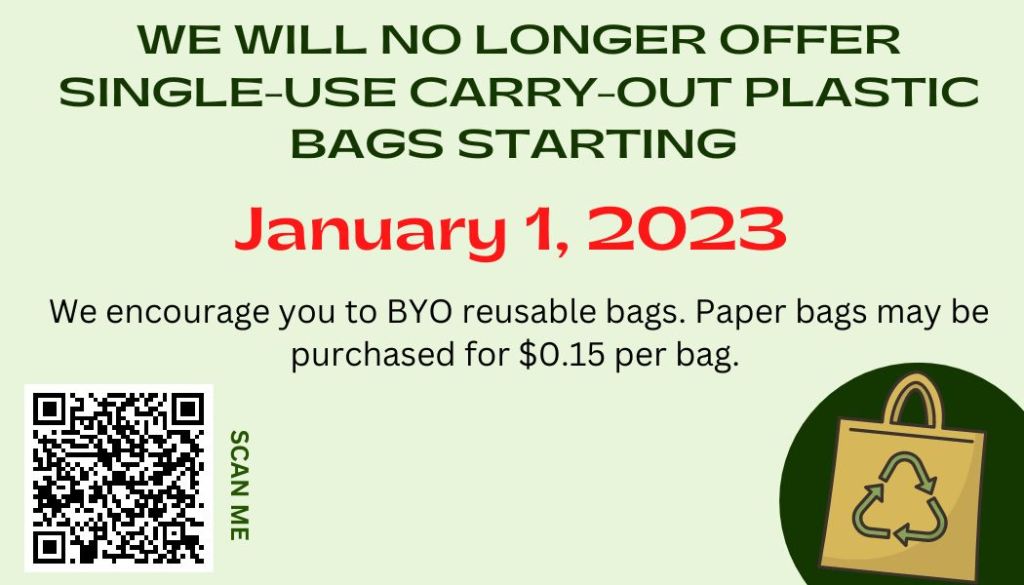
On January 1, 2023, Easttown’s ban went into effect. You can find a comprehensive FAQ page on the Easttown site. Download the 2-sided pdf designed for commercial establishments here.
Click here for the text of Easttown’s very useful and well-footnoted 2022 “Economics of Single Use Plastic Bags” document, showing how—alongside the environmental benefits, of course—retailers, recycling facilities and municipalities gain financially from a reduction in plastic waste. Here are the concluding paragraphs:
…Beyond global energy and emissions constraints, the major environmental risk posed by single use plastic bags is their inability to decompose. Over time, plastics degrade to smaller microplastics that can be ingested by the smallest species at the base of our aquatic and terrestrial food webs. Ultimately, limiting single use plastics in the food web limits our own intake of plastics from our food and water sources.
In summary, plastic bag bans reduce all these costs for municipalities, costs which are passed on to residents, by reducing the amount of plastic pollution and waste we need to handle. For businesses the impact is that a plastic bag ban with a fee on other bags reduces overall single use bag use. With less demand for bags, businesses don’t need to purchase and stock as many bags, saving them costs. And although paper is more expensive than plastic, having a built-in fee for paper bags covers the difference, so businesses don’t need to pay more.
Model handout for Easttown retailers:
Group calls on Gov. Wolf to veto proposal
By Clean Water & Conservation Advocate Stephanie Wein, PennEnvironment. For Immediate Release Wednesday, November 18, 2020

PHILADELPHIA– PennEnvironment called on Gov. Tom Wolf Tuesday to veto a newly passed bill that would redefine the term ‘recycling’ in a way that benefits the fossil fuel industry and threatens the health of Pennsylvanians and our environment. Earlier in the day, the Pennsylvania State Senate passed House Bill 1808, which would promote burning plastics and turning them into crude oil and jet fuels under the guise of “recycling.” HB 1808 would also weaken pollution control standards for facilities where plastic-to-fuel processes take place, while incentivizing the production of more single-use plastic.
PennEnvironment’s Clean Water & Conservation Advocate Stephanie Wein released the following statement in response:
“Governor Wolf should stop Pennsylvania from setting a horrible precedent by misleadingly defining plastic combustion and other practices promoted by HB 1808 as ‘advanced recycling.’ Just like calling a hot dog ‘sushi’ doesn’t make it sushi, calling burning plastics ‘recycling’ doesn’t change what it is: just another way to burn fossil fuels.
This bill classifies expensive, polluting processes such as pyrolysis and gasification that convert plastics to liquid fuel products like fossil-fuel derived jet fuel or crude oil as recycling. We shouldn’t waste time and money on these types of flawed and potentially dangerous waste management approaches. Instead, we should implement safer, proven strategies such as passing policies that limit the use of single-use plastics in the first place.
We know that burning fossil fuels lead to global-warming carbon emissions. The plastics-to-fuel facilities enabled by HB 1808 will only exacerbate our climate-related problems. One project currently being proposed in Pennsylvania would emit an estimated 1.75 million tons of global warming pollution annually – the emissions equivalent of 300,000 cars on the road.
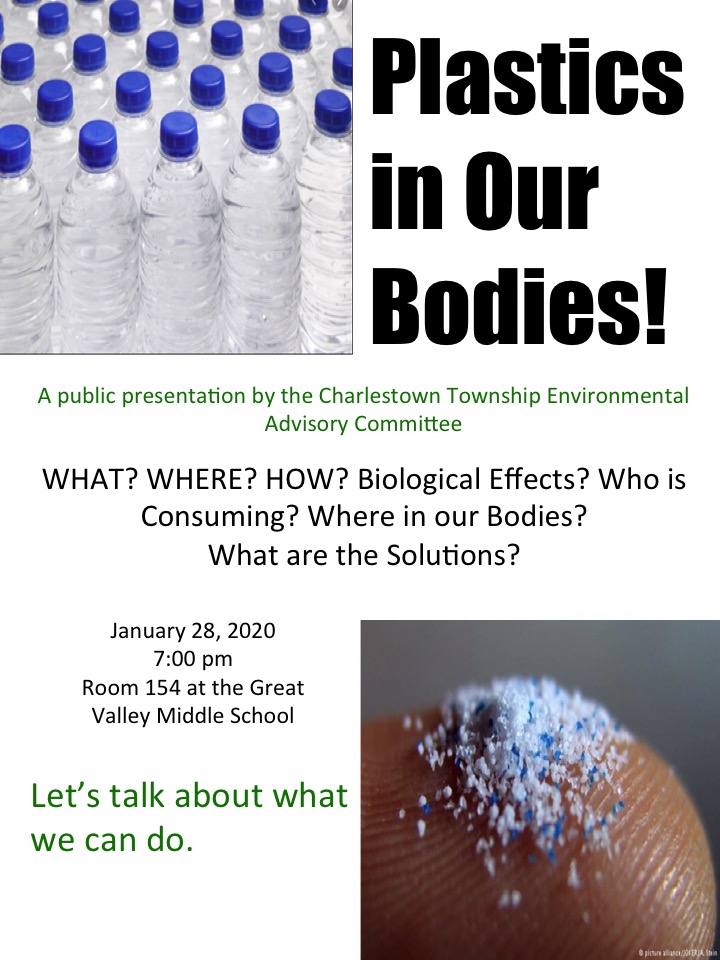
You are invited to the Charlestown Township Environmental Advisory Committee’s presentation on January 28 at 7p on the impact of plastics, which will include updated information, and discussion of solutions. It is held at the Great Valley Middle School Choral Room (Rm. 154), 255 Phoenixville Pike, Malvern PA 19355. Light refreshments are provided.
Sierra magazine. Le Bateau Ivre, 2015, is one of several hard-hitting examples from Spanish artist Pejac.

by Plastic-Free Please Action Group
1. Plastic does not go away. Only 9% of it is actually recycled (know your facts). Plastic cannot biodegrade; it breaks down into smaller and smaller pieces, which will end up in our food.
2. Plastic negatively affects our health. Toxic chemicals leach out of plastic and are found in the blood and tissue of nearly all of us. Exposure to them is linked to cancers, birth defects, impaired immunity, endocrine disruption and other ailments.
3. Plastic spoils our groundwater. There are thousands of landfills in the United States. Buried beneath each one of them, toxic chemicals from plastics drain out and seep into groundwater, flowing downstream into lakes and rivers.
4. Plastic attracts other pollutants. Chemicals in plastic which give them their rigidity or flexibility (flame retardants, bisphenols, phthalates and other harmful chemicals) are oily poisons that repel water and stick to petroleum-based objects like plastic debris. So, the toxic chemicals that leach out of plastics can accumulate on other plastics. This is a serious concern with increasing amounts of plastic debris accumulating in the world’s oceans.
5. Plastic threatens wildlife. Wildlife become entangled in plastic, they eat it or mistake it for food and feed it to their young, and it is found littered in even extremely remote areas of the Earth. In our oceans alone, plastic debris outweighs zooplankton by a ratio of 36-to-1.
6. Plastic piles up in the environment. Americans discard more than 30 million tons of plastic a year. Only 8% gets recycled. The rest ends up in landfills, is burned or becomes litter.
7. Plastic poisons our food chain. Even plankton, the tiniest creatures in our oceans, are eating microplastics and absorbing their hazardous chemicals. The tiny, broken-down pieces of plastic are displacing the algae needed to sustain larger sea life that feed on them.
8. Plastic costs billions to abate. Everything suffers: tourism, recreation, business, the health of humans, animals, fish and birds—because of plastic pollution. The financial damage continuously being inflicted is inestimable.
by Paige Vermeulen, West Chester Green Team, 7/22/19
In late June, PA Governor Wolf signed a state budget to which the General Assembly added an amendment that blocks municipalities from passing plastic bans. But West Chester became the first municipality to stand up against this legislation by passing a ban anyway — because the plastic crisis can’t wait any longer.
From “West Chester Passes Ban of Single-Use Plastic Bags and Straws,” by Justin Heinze, West Chester Patch, 7/19/10:
WEST CHESTER, PA — Before a packed crowd at borough hall Wednesday night, West Chester made history, voting to become the latest Pennsylvania municipality to pass a ban on single-use plastic bags and straws. It comes as local governments spar with the conservative state legislature that has sought to make such ordinances illegal.
West Chester’s borough council voted 4-3 to approve the ordinance. The vote comes less than a year after nearby Narberth became the first municipality in all of Pennsylvania to pass a similar measure. And it passed despite concerns expressed by council members early in the meeting that the measure defied state law.
“It is incumbent upon council to resist and if you’re going to resist, resist completely,” State Sen. Andy Dinniman (D-Chester) told the gathering. “This is a clear overreach of local control.” …
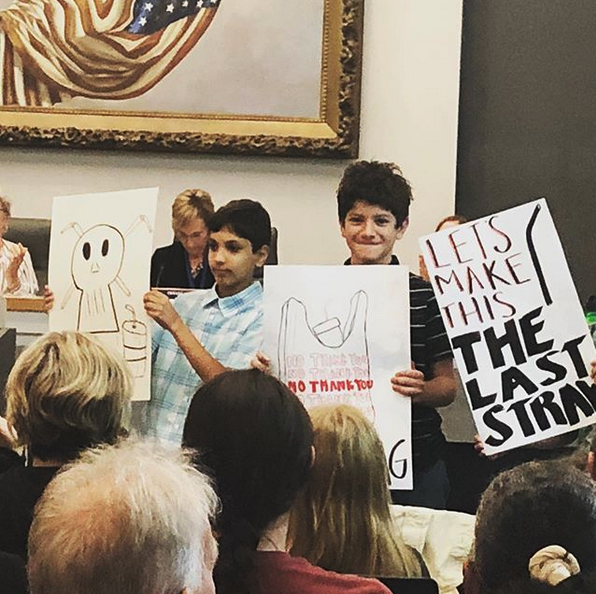
Please read the full article HERE at Patch.com.
 Chester County Environment Alliance